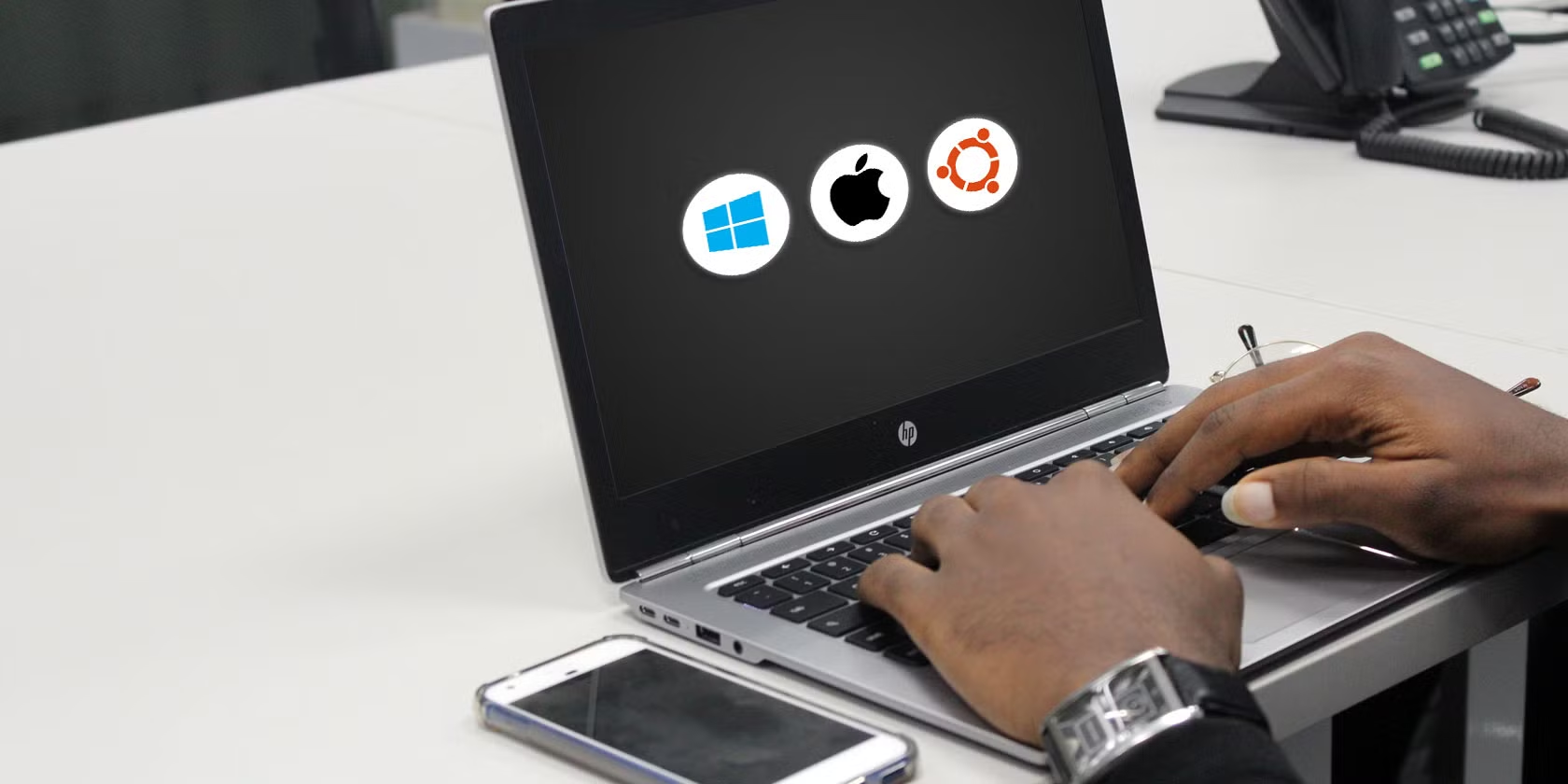
We live in a world where we are spoiled for choice. When it comes to computers, most of us stick to what we know. If you bought a PC, you probably use Windows. If you bought a MacBook, you use macOS. But the world of computing is so much bigger than just one operating system. There is the vast, customizable world of Linux with all its different flavors. There are older versions of Windows that run classic games perfectly. There are even specialized systems for coding and hacking.
The problem is that your computer usually only comes with one “brain” installed. So, what do you do if you want to try something new? What if you need Windows for your job but you love the look of Linux for your personal use? Do you have to buy a second computer? Absolutely not. You can teach your current computer to be bilingual. You can make it run two, three, or even more operating systems.
There are two main ways to do this: Dual Booting and Virtual Machines. Both have their fans, and both have their downsides. Choosing between them can feel like a technical headache, but it doesn’t have to be. In this guide, we are going to break down exactly what these technologies are. We will use simple, plain English to explain how they work, the pros and cons of each, and how you can set them up yourself this weekend. By the end of this post, you will have the power to transform your computer into a multi-tasking powerhouse.
Understanding the Basics What Is Dual Booting Anyway
Let’s start with the concept that sounds the most intense: Dual Booting. Imagine your computer’s hard drive is a big, empty house. When you buy the computer, Windows moves in and takes up every single room. It puts its furniture everywhere. Dual booting is like building a wall right down the middle of that house. You keep Windows on one side, and you move a new tenant—let’s say, Ubuntu Linux—into the other side.
When you turn on a dual-booted computer, it stops at the front door and asks you a question: “Who do you want to visit today?” You have to make a choice. If you choose Windows, the computer ignores the Linux side completely. It boots up, and for all intents and purposes, it is a Windows machine. It uses 100% of your processor, your graphics card, and your memory. If you restart and choose Linux, the Windows side goes to sleep, and the computer becomes a pure Linux machine.
This is the key to dual booting. It is a “one at a time” relationship. You cannot use Photoshop in Windows and then instantly switch to a Linux terminal without restarting the computer. However, because only one system is running at a time, that system gets full access to your hardware. It is fast, powerful, and perfect for demanding tasks.
What Is a Virtual Machine and How Does It Work
Now, let’s look at the alternative: the Virtual Machine, or VM. If dual booting is splitting a house into two apartments, a Virtual Machine is like building a dollhouse inside your living room. You are running a computer inside a computer.
Here is how it works. You boot up your main operating system (let’s say Windows) just like normal. Then, you open a program called a “Hypervisor.” This program opens a window on your desktop. Inside that window, a completely different operating system boots up. You could be typing a report in Microsoft Word in your main Windows environment, and in the window next to it, you are running Linux to check your email.
The magic of a Virtual Machine is that it is a simulation. The “guest” operating system (the one inside the window) thinks it is a real computer. It has a fake hard drive, a fake graphics card, and fake memory, all created by the software. But in reality, it is borrowing resources from your main computer. This means you can run both at the same time. You can drag and drop files between them. You can copy text in Windows and paste it into Linux. It is incredibly convenient, but because you are running two systems at once, they have to share the power.
The Pros and Cons of Dual Booting for Performance
So, why would you choose one over the other? Let’s look at dual booting first. The biggest advantage is raw performance. When you dual boot, the operating system is running on the bare metal of your hardware. There is no middleman. If you are a gamer, this is the only real choice. You cannot play heavy 3D games effectively in a virtual machine because the graphics card cannot share its power efficiently. If you want to play a Windows-exclusive game but your main daily driver is Linux, you dual boot Windows just for the games.
It is also better for hardware access. If you are doing low-level coding where you need to talk directly to the Wi-Fi card or the USB ports without any interference, dual booting is better.
The downside? It is inconvenient. Switching between systems requires a full restart. You have to save your work, shut down, wait for the boot menu, pick the other OS, and wait for it to load. This friction stops many people from actually using the second system. Also, setup can be risky. If you make a mistake while partitioning the drive, you can accidentally delete your main operating system. It requires a bit of bravery.
The Pros and Cons of Virtual Machines for Safety
Virtual Machines are the opposite. Their biggest strength is safety and convenience. Because the “guest” OS is just a file on your hard drive, it is “sandboxed.” This means that if you get a nasty virus inside the virtual machine, it cannot escape. It stays trapped in the simulation. You can simply delete the VM file and start over, and your main computer remains perfectly safe. This makes VMs perfect for testing software, browsing sketchy websites, or learning cybersecurity.
The convenience factor is huge. You don’t have to restart. You can pause the VM, go eat dinner, and come back and unpause it exactly where you left off. You can take “snapshots,” which are like save points in a video game. If you are about to try a risky update, take a snapshot. If it breaks the system, you just click “restore” and you are back in time instantly.
The downside is the “performance tax.” Because your computer is running two operating systems at once, everything is slower. If you have a slow laptop with only 8GB of RAM, a VM will struggle. The animations might be choppy, and apps might take longer to open. It is generally not good for video editing or gaming.
How to Choose the Right Setup for Your Needs
Choosing between these two depends entirely on what you want to do. Ask yourself a few simple questions. First, how powerful is your computer? If you have a brand new, high-end PC with tons of RAM and a fast processor, you can run a Virtual Machine without even noticing the slowdown. If you have an old, budget laptop, a VM might make it crawl, so dual booting would be better to squeeze out every drop of speed.
Second, what is your goal? Are you a student learning to code? A VM is perfect because you can break it and fix it easily. Are you a gamer wanting to play Call of Duty on a Linux machine? You need to dual boot Windows. Are you a software developer who needs to test an app on Windows, Mac, and Linux all at once? VMs are the standard tool for this.
For most beginners, I always recommend starting with a Virtual Machine. It is risk-free. You cannot accidentally wipe your hard drive. If you find that the VM is too slow for your needs, or you really love the new OS and want to use it full-time, then you can graduate to a dual boot setup later.
Setting Up a Virtual Machine A Step by Step Guide
Ready to try a VM? It is surprisingly easy. You need two things: a Hypervisor and an ISO file. A Hypervisor is the software that runs the VM. The most popular free option is VirtualBox. It works on Windows, Mac, and Linux. Another great free option for Windows users is VMware Workstation Player. Download and install one of these just like any other app.
Next, you need the “ISO.” This is a digital copy of the operating system installation disk. If you want to install Ubuntu Linux, go to the Ubuntu website and download the ISO file. It is free. Now, open VirtualBox and click “New.” Give your VM a name (like “My Linux Machine”). It will ask how much memory (RAM) to give it. A good rule of thumb is to give it half of what your physical computer has. If you have 16GB, give the VM 8GB. It will ask to create a “Virtual Hard Disk.” This is just a file on your computer that acts like a hard drive. 25GB is usually enough for Linux.
Once the “machine” is created, you need to insert the “disk.” In the settings menu, look for “Storage,” click on the empty CD icon, and select the ISO file you downloaded. Now, click “Start.” A window will open, and you will see the installation screen of the new OS. Follow the prompts just like you were installing it on a real computer. When it finishes, you have a fully functional computer living inside a window on your desktop.
Setting Up a Dual Boot System The Safe Way
Dual booting requires a bit more care. The most important step here is the backup. Because we are going to be resizing the partitions on your hard drive, there is a small chance of data loss. Take an external hard drive and back up your important photos and documents before you start.
You will need a USB stick (at least 8GB). You also need the ISO file of the operating system you want to install (e.g., Linux Mint or Windows 10). You need a tool to put the ISO onto the USB stick and make it bootable. A free program called “Rufus” (for Windows) or “BalenaEtcher” (for Mac/Linux) is perfect for this. Plug in your USB, open Rufus, select the ISO, and click “Start.” This will erase the USB stick and turn it into an installer.
Next, you need to make space on your hard drive. In Windows, you can use a tool called “Disk Management.” Right-click your main drive (usually C:) and select “Shrink Volume.” This tells Windows to huddle up and make some empty space at the end of the drive. Shrink it by however much space you want the new OS to have (e.g., 50GB).
Now, leave the USB stick plugged in and restart your computer. As it turns on, you need to press a special key to enter the “Boot Menu.” This is usually F12, F2, or Delete, depending on your computer brand. Select the USB stick from the menu. The installer will launch. When it asks where to install, look for the option that says “Install alongside Windows.” This is the magic button. It will automatically find that empty space you created and put the new OS there. Follow the instructions, and when you reboot, you will see a menu letting you choose between Windows and your new OS.
Common Pitfalls and How to Avoid Them
The road to a multi-OS setup has a few bumps. One of the most common issues in dual booting is the “Bootloader.” The bootloader is the first little program that runs and asks you which OS to pick. In the Linux world, this is usually called GRUB. Sometimes, Windows updates can be aggressive and overwrite GRUB, causing your Linux option to disappear. To fix this, you often have to boot from your USB stick again and run a “Boot Repair” tool. It is annoying, but fixable.
Another pitfall is time synchronization. Windows and Linux handle time differently. Windows assumes the hardware clock is set to your local time. Linux assumes the hardware clock is set to UTC (Universal Time) and then adds your time zone offset. This means every time you switch OS, your clock might be off by a few hours. There is a simple registry fix in Windows to force it to use UTC, which solves the problem permanently.
In Virtual Machines, the biggest pitfall is the “Guest Additions” or “VMware Tools.” After you install the guest OS, the screen might be tiny, and the mouse might be laggy. You need to install a special set of drivers inside the virtual machine called Guest Additions. This allows the VM to go full screen, share the clipboard, and run smoothly. Beginners often forget this step and think VMs are just naturally slow and ugly. They aren’t; you just need the drivers!
Exploring the World of Containers A Third Option
If you are a tech enthusiast, you might have heard of “Docker” or “Containers.” This is a third option that sits somewhere between a VM and running an app natively. Containers are very popular with software developers.
Think of a Virtual Machine as a house with its own plumbing, electricity, and furniture. It is heavy. A Container is like a tent. It uses the plumbing and electricity of the main house (the host OS) but creates a private space for the app to live. This makes containers incredibly fast. They start in milliseconds.
While containers are mostly used for running servers or databases, they are becoming easier for normal people to use. You can’t really “dual boot” a container to use as a desktop, but if your goal is just to run a specific Linux program on Windows without the heaviness of a VM, looking into Docker or the “Windows Subsystem for Linux” (WSL) is a great idea. WSL allows you to run a Linux terminal directly inside Windows without setting up a traditional VM. It is the future of how these operating systems interact.
Conclusion Unlock the Potential of Your Hardware
Your computer is capable of so much more than what it came with out of the box. Whether you choose to slice your hard drive in half with a dual boot setup or build a simulation with a Virtual Machine, you are taking control of your technology. You are no longer limited by the walls of one ecosystem.
If you are nervous, start with a Virtual Machine. Download VirtualBox today. It is free, it is safe, and you can delete it in five seconds if you hate it. Try installing an old version of Windows to play Pinball. Try installing a hacker version of Linux like Kali to learn about security.
Once you get comfortable with the concepts of partitions, ISOs, and bootloaders, the fear disappears. You realize that an operating system is just software. It can be installed, deleted, and reinstalled as many times as you want. Dual booting gives you the best of both worlds—the gaming power of Windows and the privacy of Linux—on a single machine. It turns one laptop into two. So go ahead, back up your data, grab a USB stick, and start exploring the multiverse of operating systems. The only limit is your curiosity.